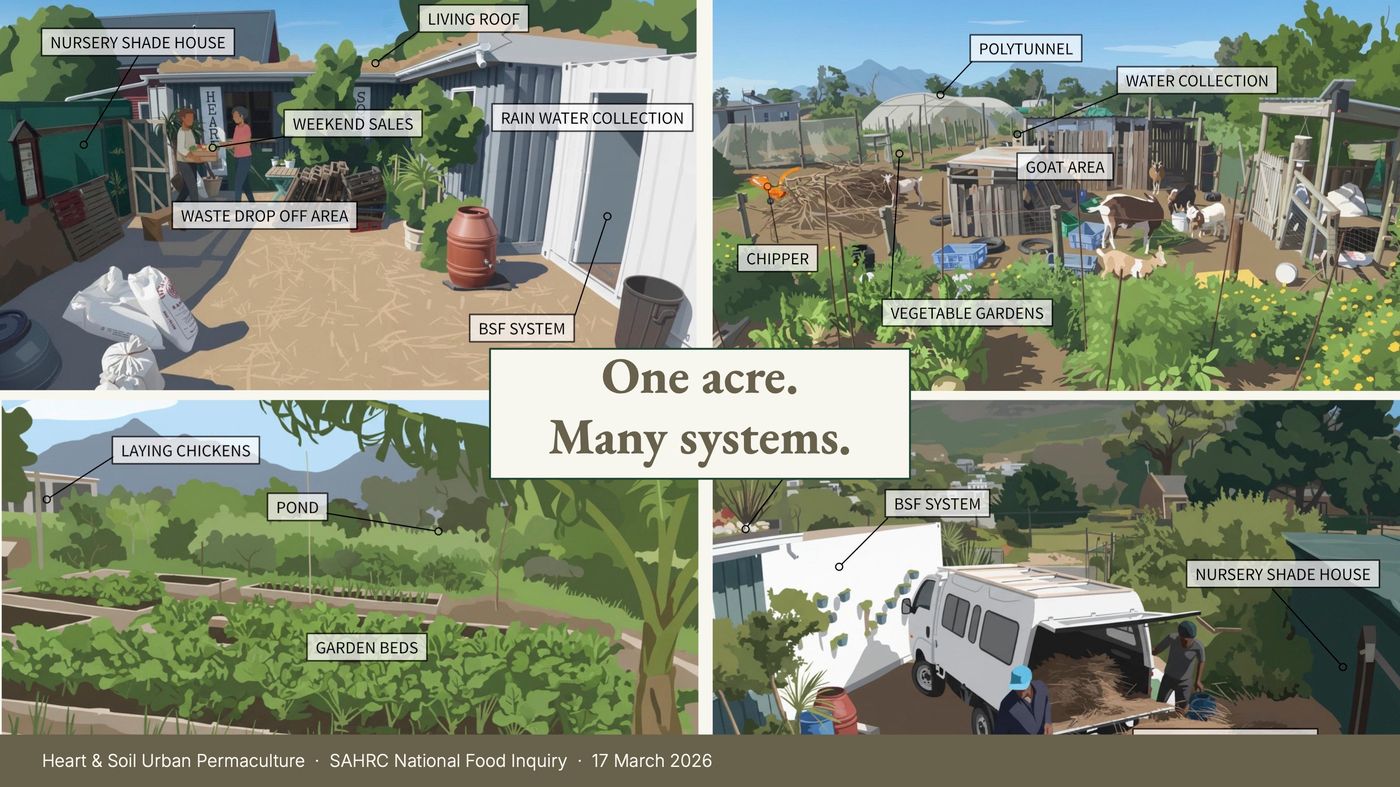
Food Forests in Cape Town: Growing One in a Dry, Windy Climate

Water, shade, wind, food, life.
If you google “food forest,” you’ll read that a food forest is meant to mimic nature. But what type of nature? Nature where?
We have a food forest! Kind of! Maybe! Yet what a forest looks like depends on the context — wind, water, pots of gold — we find ourselves in. I’ve previously written about growing fruit trees in Cape Town, but I wanted to write specifically about the concept of a food forest, and what it might look like in areas without summer rainfall.
When I was first introduced to permaculture, it was the prospect of integrated growing — the aesthetics and functionality of a food forest — that excited me most. This is where permaculture is potentially visionary: we can create a space that provides beauty, food for people, habitat and food for animals, medicine, and biomass.
But sometimes permaculture is weaker on the details, because the details are so context-dependent. I think this is good! In our context, we have to build a lot of our own hard-won insight. It has to be a lived practice rather than a theoretical system, and it’s ever-evolving.
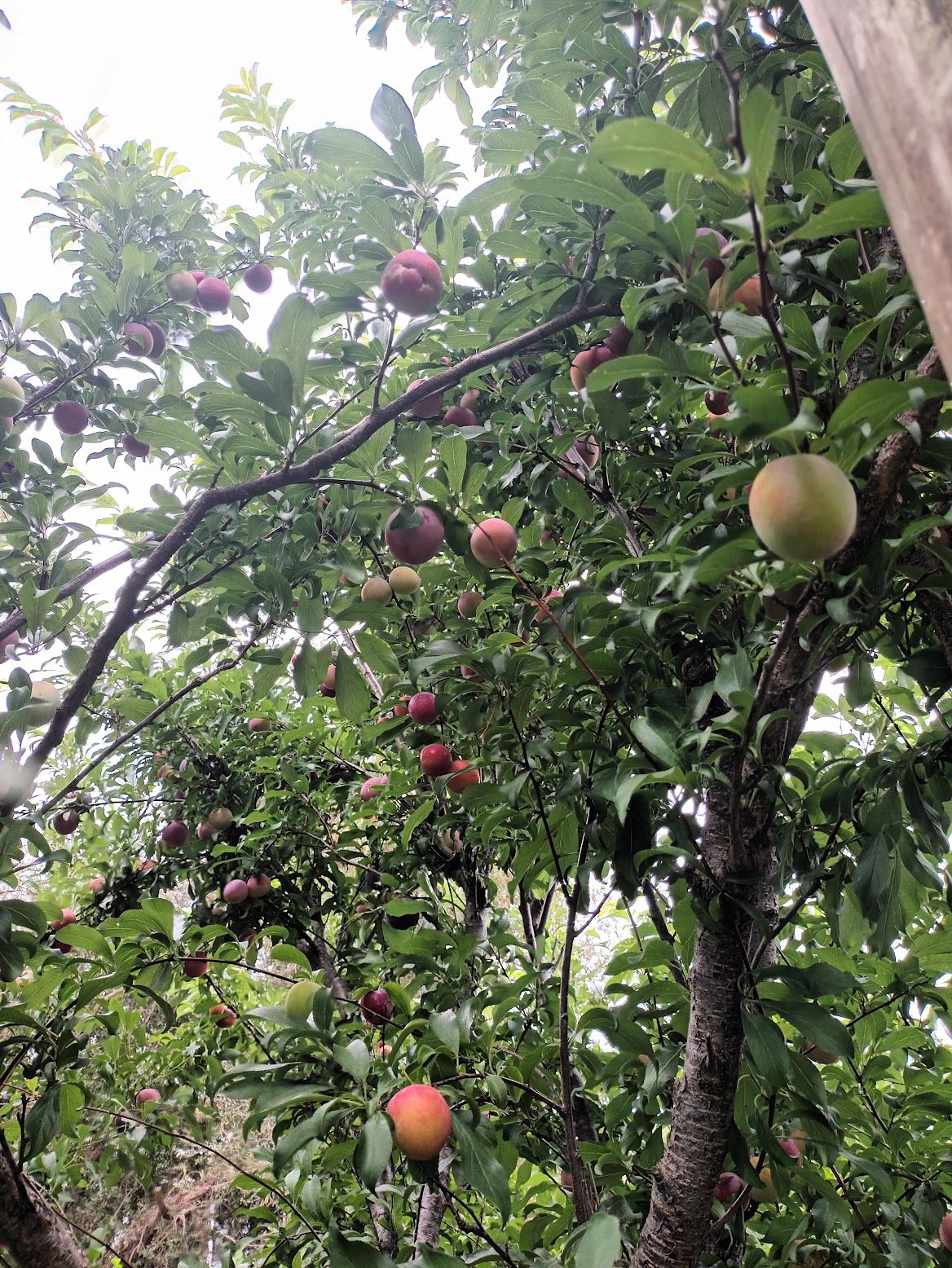
Many of the mature food forests I’ve encountered are in places with much more rainfall, and much less wind, than our environment. They’re places that might naturally have forests.
In places where there wouldn’t naturally be forest, the questions are a little different: could it be sustainable to have a forest in our area under human cultivation? How? What are the implications, and how could it be so?
What are you actually seeing when you see a food forest, and how can you interpret, enjoy and learn from it? If you’re creating a planting at a school on the Cape Flats, what is the goal, and how might you create something that will last? Productivity over decades is far more sustainable than quick bursts of productivity followed by disaster and recovery.
Naturally occurring forests in Cape Town
Forests do occur naturally in the Cape. If we look up at our mountains (Newlands Forest, Skeleton Gorge), at the milkwoods on our coasts, and at riparian strips along rivers with wild olive, Cape ash, keurboom, waterberry, rooiels, yellowwood and wild almond.
There are also places where a forest can occur made up of very invasive species like Port Jackson, which can fix nitrogen and survive in very dry contexts. In fact, our property was well on its way to becoming a forest of Port Jackson when we moved here.
To have a productive food forest in this area generally requires intervention.
There are also large areas of Cape Town, including most of the Cape Flats, that would naturally be strandveld: wind-pruned, low thicket. In these contexts, mimicking lower, denser, self-sheltering food “thickets” may be a better analogue than a food forest.
The forest contexts tend to be fire refuges, often sheltered from wind, with subsurface water of some kind. So when we try to create a food forest, we’re really trying to mimic the conditions of these places: shelter, moisture, some wind protection.
Borrowing from the structure of forests
Layering
Succession
Soil cover
Root partitioning at different depths — different plant layers draw from different depths
Nutrient cycling
Self-shading
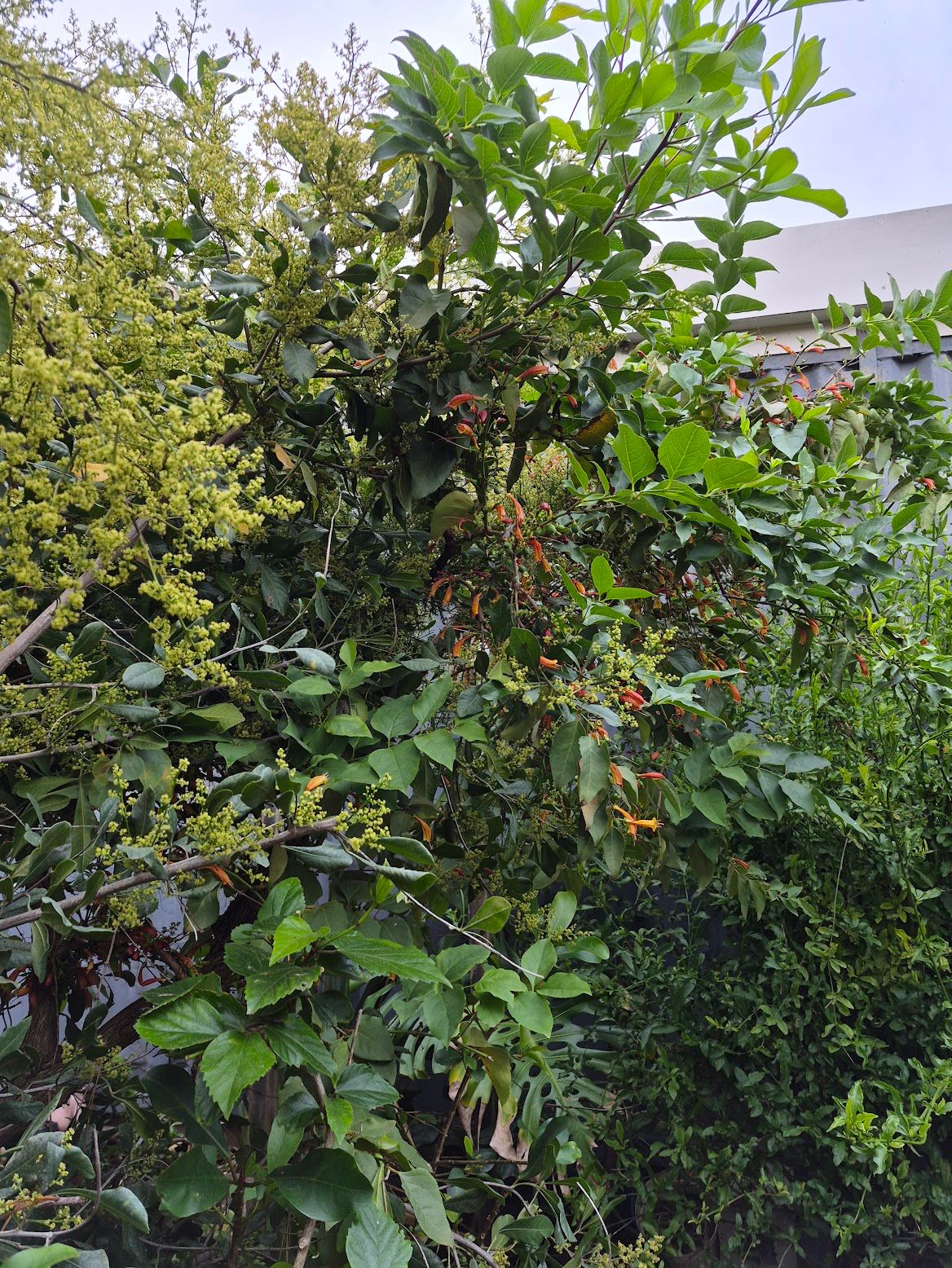
These processes are perhaps the most powerful learning tools when you’re thinking about your own space. You’re constantly making trade-offs: if you add shade you can reduce watering, but you also potentially increase root competition and reduce yield.
Mimicking nature is not the same as neglect or lack of design
When I planted our first pomegranate, I had this idea that mimicking nature meant choosing hardy fruiting species and then letting them figure it out. “Figuring it out” mainly meant dying.
Fruit trees are generally cultivated species. Some need less work than others, but you have to pay attention to their needs and carefully consider how to meet them within the constraints of your space, time and money.
Using large pots and bags, sheltered by existing structures, can help. If you can get trees and shrubs hardened off and large enough — close to the environment where they’ll be planted out — you’ll have fewer losses.
The goals of a food forest
It’s too easy to be vague about goals. But a clear ranking of your priorities helps a lot when deciding on your design.
Calories per square metre. A food forest is generally poor at this. An irrigated annual bed does better. That’s why our farm has both: we concentrate attention and irrigation in higher-yield annual plantings, and value the food forest for some the goals below. Still, pay some attention to harvestable yield, or it’s no longer a food forest.
Low input once established. I think of our food forest as a kind of retirement plan, with a ten-year plan that connects many of our annual beds into it. But getting fruit trees started, even with shelter and water, takes attention, compost and care.
Shade and cooling. Creating shade and cooling in an urban space is meaningful. Even eleven years in, much of our food forest still isn’t at canopy height, but the abundance of plants creates significant shade and cooling.
Soil building and infiltration. Turning a hard, hydrophobic surface into a sponge is a huge ecological benefit.
Habitat and biodiversity. A food forest creates shelter and habitat; the more diverse your planting, the more diverse your ecology.
Beauty, place, and somewhere to walk with your kids. One of the biggest differences between an orchard and a food forest is the experience of walking through it, observing and enjoying it together.
Demonstration and teaching. Most people can’t recognise fruit trees and just see an overgrown mess. Imagining who will walk through, and what their experience might be, helps broaden the benefits.
Fire resilience. An irrigated, high-moisture, deciduous planting on the urban edge is less flammable than fynbos or gum, and can act as a green break.
The seven-layer diagram
For the most part, this diagram assumes rainfall that coincides with the growing season — which would need a tremendous amount of water in our context. Dry-climate traditions look really different: olive, fig, vine and almond widely spaced over open ground; the Spanish dehesa; North African oasis agroforestry (date palm over citrus over vegetables) — stacked, but only because there’s a spring underneath.
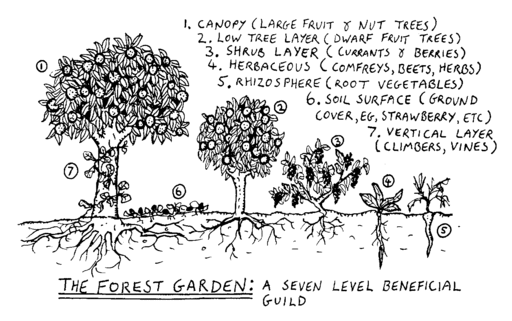
Still, it’s useful: it suggests we can stack layers where we have water (say, around greywater systems), and spread food-producing trees where we don’t.
More on water
Because we don’t have summer rainfall, we face a choice: build our systems to accommodate that, or find ways to mobilise huge amounts of water in summer.
Figs, olives, pomegranate, almond, grape, carob, mulberry, and deciduous stone and pome fruit are less water-hungry than subtropical, large-leaved species like banana, mango and avocado.
One mature fruit tree in peak summer needs hundreds of litres of water over the season. Multiply that by the number of trees you have or want and it gets a bit terrifying. Rainwater-tank capacity simply can’t cover both vegetables and fruit trees adequately; winter rainwater is more of a supplement.
But there are things you can do:
Build water storage into your landscape. Deep mulch, shade, swales, and good soil over time. It’s cheap, it lasts, and a single rain event can create massive storage.
Grow or build proper windbreaks. Wind removes more water than heat does — plant windbreaks before you plant food-bearing trees. A windbreak is the highest-leverage intervention in most places.
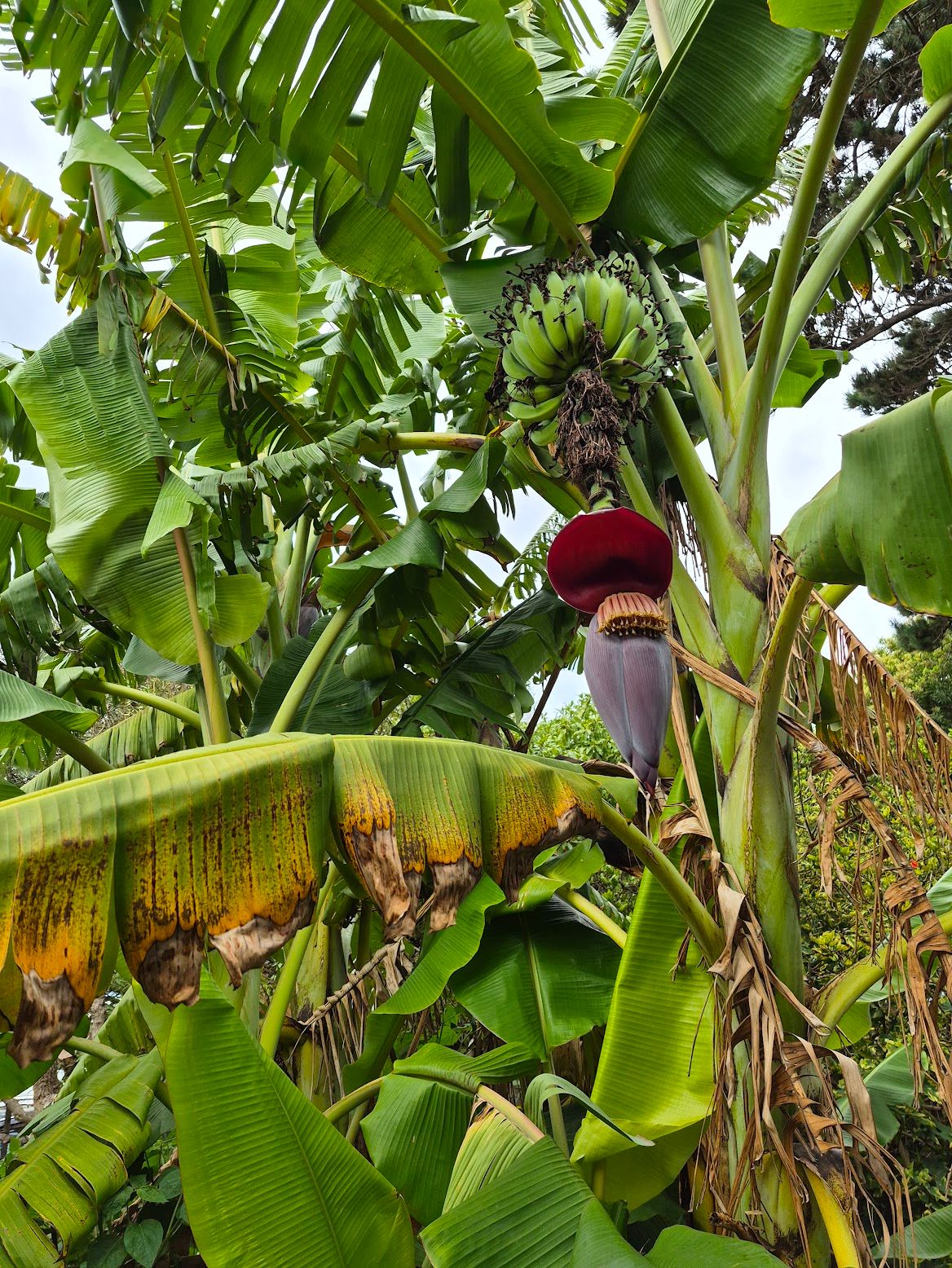
Use greywater. Greywater is year-round and can create oases that transform the surrounding landscape. Our bananas are all grown on runoff or greywater, which lets us grow some high-water trees.
Integrate layers with structures, like shipping containers.
Human management, nature, and the limits of both
When we watch videos of food forests, we’re seeing a snapshot of one successful process, and it’s very hard to extrapolate everything we need. We’re sometimes watching twenty years of someone’s life in ten minutes!
A food forest isn’t ultimately less work than an orchard — it’s just different. That actually makes it harder, because it takes a lot of judgement and is very hard to delegate. It requires long-term, institutional memory. If you’re starting one in a space with staff turnover, building systems for memory, training and human succession is as important as the food forest itself.
In urban spaces, one of our biggest resources is organic urban waste. Tapping into it is a primary way to add fertility and water-holding capacity and speed up progress. Eleven years in, we could now survive as a closed loop — but that’s not how we built our system, and it would have been extremely difficult without the urban waste we received.
It’s impossible to manage your way out of water deficit or wind exposure, so look at these head-on before you start. In many projects they’re budgetary issues — wind protection and water systems can be a matter of money.
Animals in a food forest
This one’s already getting long, so I’ll save this section for another day!
Land tenure
A food forest takes a long time to establish, and on municipal or rented land, the question of who plants versus who eats is vital. I don't have great answers for this question, but I think it should be front and centre of many discussions.
What we’d do differently next time
Start with many more indigenous and windbreak trees. We didn’t immediately remove our Port Jackson (probably a good thing), but I wish I’d paid more attention to indigenous trees and shrubs — camphor, coastal oak, milkwood, karee, Cape saffron, keurboom, pelargoniums, wild rosemary — plus lavenders, rosemary and hardy shrubs. These are the plants that actually turned our landscape into a softer, more habitable place.
Start all our fruit trees around the greywater system, radiating outwards.
Figure out water before planting trees!
I’d love to hear about your own food forest efforts, and how you’re thinking about priorities in your space. I hope this can be a resource you look back on.
For more on growing in our climate, subscribe to our weekly newsletter — we share ideas from our urban permaculture farm every week.